


Please be aware that the certification criteria listed below are meant to ensure that each participant graduating the Agama 200 HR TTC is ready to teach and represent Agama Yoga, in terms of maturity, knowledge, spiritual attitude and teaching skills, as evaluated by a team entrusted by Swami Vivekananda Saraswati. Receiving this certification means more than merely having passed the course, it is vote of confidence from Swami personally to you as a Yoga teacher.
During the TTC, if a staff member becomes aware that a student may fail to meet any of these criteria, the Agama Administration will be notified and the matter will be promptly investigated. We reserve the right to deny certification to any student who does not fulfill the course criteria, as detailed below. In the event that certification is withheld, it will be at the sole and final discretion of Swami Vivekananda if an exception will be made (see the Certification by Exception section below).
Please read carefully the following list of rules and requirements. Teachers and practicum supervisors will be monitoring and evaluating all students on a daily basis, in order to support every student to succeed in this course. If you have any questions regarding the criteria address these to your TTC Coordinator.
ATTENDANCE
With the exception of emergencies, Agama expects Full Attendance of all TTC sessions starting from Monday of week 1 in order to earn the certificate issued at the end of the course. A student is allowed to be absent from no more than 3 sessions during weeks 1-5. If the number of unapproved absences is greater than this, the student risks failing the course. Attendance will be monitored in every session of the course, including joint classes with the First Level Intensive.
“Full attendance” is defined as participation in all scheduled sessions, including: theoretical presentations, Hatha Yoga classes, sun salutations, meditations, Q&A sessions, interviews, and practicums. A late arrival of 5 minutes or more to any of these sessions is considered an absence. Leaving before the final relaxation of a hatha class, or before the teacher has announced that the class is over, is considered as absence. Excessive talking, note passing, sleeping during sessions, and other disturbing actions could lead to the student being dismissed from class and marked as absent.
“Approved absence” from a session can be given in the case of illness, emergency, or a scheduled visa run/visa extension (in this case 1 day of absence is permitted). Please make sure to inform the TTC Coordinator, well in advance, on which day you will have to be absent due a visa run or visa extension. Unless you are using your visa days to the max, and therefore have no flexibility around what day you can schedule the trip, it is recommended to consult with the Coordinator which day is the least problematic to miss. Also, when possible, contact the TTC Coordinator before missing a class due to illness or emergency, to ensure approval of the absence. Unless your condition is very bad, or possibly harmful to the other students, the Coordinator might ask you to still join the class. For example, in the case of a hatha Yoga session, even if you are weak or ill, you might be told to sit in the back and meditate. In the situation of a student being sick or “not well”, each case will be evaluated individually by the Coordinator and fellow teachers, based on this evaluation of the student’s condition further direction in terms of approved absence and recovery will be given.
If a student is absent more than the allowed margin due to a legitimate reason, such as an illness or other valid emergency, they may join a future TTC, at a cost of 25% of the course fee. If re-attending, the outlined criteria for certification must be adhered to. If a student fails to meet these requirements for a second time, they may re-apply to attend a future TTC, in this case the full program fee will be required. The approval for re-entering the program is at the discretion of Swami Vivekananda Saraswati.
Students may not attend any other Agama Yoga course levels, workshops, or retreats concurrently while enrolled in a Teacher Training Course.
Theoretical Exam
A final written exam will be held in the last day of the TTC. Students must obtain a minimum mark of 80% in the written exam in order to successfully receive the teaching certificate.
Practical Exam
Successful completion of a practicum teaching assignment is a requirement for certification. All pupils are expected to teach one practicum each, and to participate in all other sessions taught by fellow colleagues. Practicums must demonstrate a student’s ability to correctly use the teaching methodology taught in this course, to correctly perform the asanas and techniques practiced in the session and to correctly adjust the asanas and techniques performed by the students in the session, Finally, students must demonstrate a sound understanding of the theoretical material given in this course (see Practical Exam section).
You will get either a pass or fail on the practical exam, determined by our standard practicum criteria and the evaluation of the practicum supervisor.
Assimilation of the yogic lifestyle
We expect our Yoga teacher graduates to display a correct and inspiring personal example of the values of the yogic lifestyle. This includes abstinence from various harmful substances. This criterion is meant to allow profound personal transformation and purification to take place during and after this TTC, and to inspire new Yoga teachers to want to live up to the standards of the teachings in this school, which they represent as Agama graduates.
Full abstinence from smoking, eating meat (fish excluded), drinking alcohol and using various recreational drugs is required for certification, specifically during this course, and generally during the time that you represent Agama as a teacher.
We expect all TTC students to refrain from these substances throughout the duration of this course. However, due to the challenge of quitting smoking, we expect TTC students to be completely smoking free from week 3. If an individual is found using any prohibited substances during the course, either on or off campus, certification could be withheld. In the rare case that a student breaks this commitment, they will first receive a warning. If the criterion is broken a second time, the student risks not receiving his or her certificate, and possibly permanent expulsion from the program without refund of the course fee.
Graduation Empowerment
On the last day of the course, after successfully fulfilling all the above criteria, all graduates will receive an empowerment to teach under the support and protection of Swami Vivekananda Saraswati and Agama Yoga. Teaching Yoga entails some karmic responsibility, since it allows people to transform and evolve rapidly. Beginner teachers are not spiritually mature to carry such responsibility alone. It is Swami’s policy to offer this empowerment and protection to all teachers graduating from Agama Yoga. Therefore, this first empowerment is part of the certification criteria for the TTC and failure to attend this empowerment will lead to postponement of the certification until the next empowerment takes place.
The empowerment does not have to be attended in person, but if you cannot be physically present we require that you provide us with an analog photo of yourself and that you will participate in the meditation wherever you are at the exact same time as it takes place in the school.
Swami offers this empowerment a few times every year, though it is not compulsory for teachers to continue to participate in the empowerments after graduation, it is highly recommended to do so.
CERTIFICATION BY EXCEPTION
In the case that a student fails to fulfill one or several of the criteria listed above, resulting in his or her ineligibility for the Agama 200 HR Teacher Training Certificate, various exceptions can be permitted by Swami Vivekananda Saraswati to certify the student in question. These exceptions vary from case to case and may require the student to repeat parts of the course, the written exam, the practicum, or to fulfill other theoretical/practical conditions as decided by Swami Vivekananda.
In the case that a student has failed to fulfill the necessary criteria, he or she will be informed by the Coordinator that further discussion has to be made with Swami Vivekananda before a final decision can be made concerning certification.
Certification by exception is not a guarantee for students who fail to fulfill the criteria; it is strictly a case-by-case decision made solely by Swami Vivekananda Saraswati.
Professional and Ethical Behavior
Agama Yoga expects its teachers to represent and embody through personal example the ethical and spiritual standards of the school, which are described in the Agama Teachers’ Code. Therefore, Agama reserves the right to evaluate a teacher if a complaint is made against them, or if there is a suspicion that the Agama Standards have been breached. In such rare cases where legitimate basis for the complaint is found, Agama reserves the right to revoke or suspend certification. In these cases certain conditions have to be fulfilled in order for the teacher to get re-certified and permitted to use the name “Agama Yoga”. Ultimately, this policy is meant to reflect to the teacher certain spiritual limitations and to offer support in overcoming them, which will allow personal growth and evolution, as well as the ability to teach Yoga correctly without negative karma being created.
Use of the Name “Agama Yoga”
Use of the name Agama Yoga and the Logo are restricted by international trade mark only to be used in compliance with Agama Yoga terms and conditions.
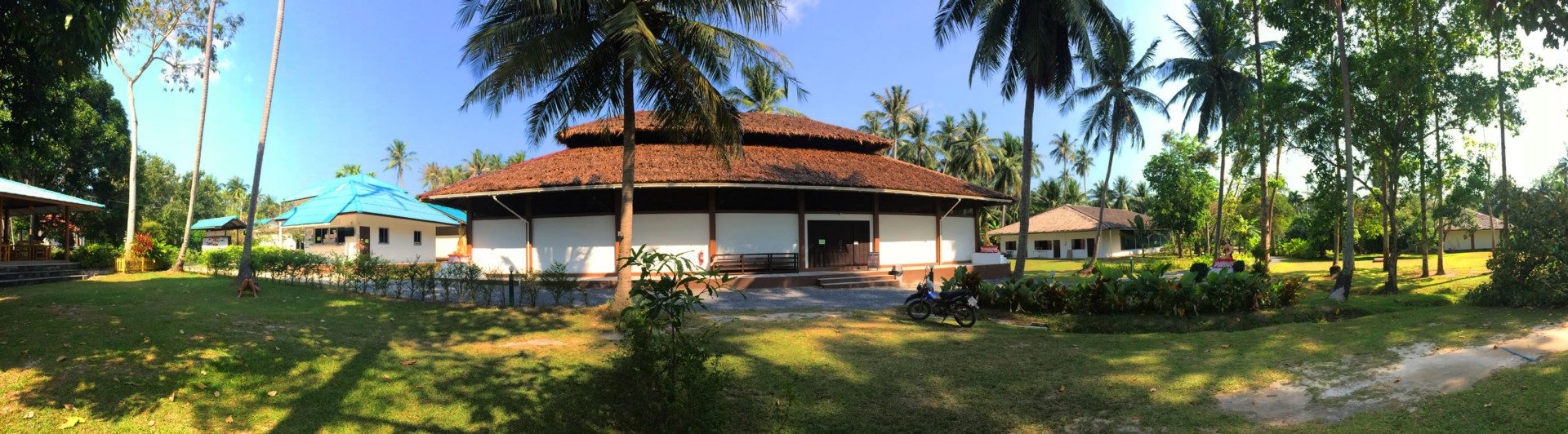
Enjoy a fresh mango and coconut for breakfast, take a Yoga class, relax on a hammock with an ocean view, and save a massage for the afternoon. These are just a few ways to spend a perfect day on the beautiful island of Koh Phangan in Thailand, where Agama is located. Nature is constantly blessing Koh Phangan with blue skies, breathtaking sunsets and short, refreshing rain showers to cool down the tropical weather.
Agama is the pioneer of Yoga on the tropical island paradise of Koh Phangan, Thailand. The school was founded on the island in 2003 by Swami Vivekananda Saraswati, a Yogi for over 30 years who has dedicated his life to teaching an authentic form of Hatha Yoga in a modern scientific approach.
Agama believes that there should be a bridge between spirituality and rational thinking, and classes are taught accordingly. The teachings are easy to implement in daily life and are often adopted immediately by students.
FOLLOW THESE LINKS TO LEARN EVERYTHING YOU NEED TO KNOW:
- Sample Itinerary for One-Day Activities
- Getting To Koh Phangan Island. Lomprayah Boat Ferry
- Lodging, Hotels, Bungalows, and Housing
- General Campus Information
- Learn Everything About the Typical Agama Experience
- Complete Koh Phangan Island Information. Phanganist
Agama is unique among Yoga schools in this world, offering a style of Yoga that combines authentic wisdom from India and Tibet with a Western mindset, giving students the rare opportunity to practice forgotten, sacred teachings from the East.
The Agama program consists of principles and techniques from various styles of Yoga, including:
- Hatha Yoga
- Kundalini Yoga
- Tantra Yoga
- Kriya Yoga
- Raja Yoga
- Karma Yoga
- Jnana Yoga
- Nidra Yoga
- Bhakti Yoga