


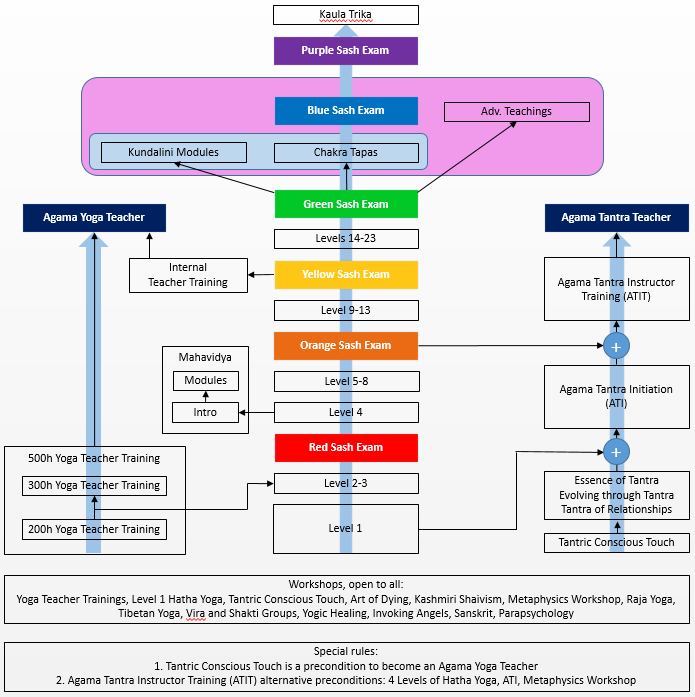
The Agama course curriculum is divided into different phases of study, which is illustrated in the graphic below. Start from the bottom up with the Hatha Yoga Program.
Hatha Yoga
The Hatha Yoga program introduces the history and basics of Yoga in its many forms in a very inspiring and empowering way over a period of 13 months. It offers all the details for an efficient practice of the techniques, as well as complete theory. The topics include:
- Full initiation into the techniques of Hatha Yoga (asanas, pranayama, mudras, etc.)
- The study of the yogic system of purification and healing (Shat Karma Kriya)
- Exploration of other traditional branches of Yoga, such as Karma Yoga, Jnana Yoga, and Bhakti Yoga
- The original use of mantra and yantra
- Transmutation and sublimation of the sexual energy, and the principles of erotic Tantra
- Nidra Yoga, conscious dreaming, and astral projection
- The colored subtle streams of energy and their applications, including the study and subtle perception of the aura
- The tantric system of meditation
- A practical study of the classical texts of Yoga (Yoga Sutra, Gheranda Samhita, Shiva Samhita, Hatha Yoga Pradipika) and Eastern philosophy.
During this first phase of the Hatha Yoga program, there are 3 Sash exams: Red Sash at the end of Level 3, Orange Sash after completing Level 8, and the Yellow Sash at the end of Level 13. After passing the Yellow Sash exam the student may continue to the second phase.
The second phase
It consists of:
- The Yoga Practitioner Program, a continuation of the Hatha Yoga program, a 10-month deepening study of Hatha Yoga, which runs as levels 14-23.
- Recently, a lot of super valuable techniques have been added, which were formerly only accessible in the advanced teachings, including profound knowledge about Svara Yoga.
After completing both the Yoga Practioner program one can take the Green Sash exam which will allow entry into the third phase.
The third phase
This phase consists of:
a) The Chakra Tapas, a unique and powerful 16-month discipline for all seven chakras, exploring their levels of consciousness. It emphasizes practice and includes an in-depth study of the chakras and their awakening mainly through Laya Yoga.
b) The Kundalini Yoga program, four one-month-long modules that focus on the awakening of Kundalini Shakti. Topics include:
- In-depth practice of Kundalini Yoga (the arousing of Kundalini Shakti, advanced mudras, bandhas, and kriyas)
- Raja Yoga, mental concentration, paranormal powers in Yoga, the arousing and use of healing magnetism, hypnotism, self-suggestion, and telepathy, psychic self-defense, and the subtle perception of previous lives
- Astrology in connection with Yoga
- Kaula Tantra techniques, and other tantric applications
The Kundalini Yoga program concludes with an intense Kundalini Retreat. The student who wishes to attend the Kundalini program is required to apply beforehand and has to pass an entrance exam in order to be accepted.
c) The Advanced Teachings that focus on the highest Tantra Yoga techniques for reaching states of supramental consciousness and arousing the crown chakra (sahasrara). These teachings include:
- Kashmir Shaivism (Trika) lineages of Pratyabhijna, Spanda, Krama and Kaula; methods for the revelation of the Supreme Self (Atman), and techniques for reaching supramental consciousness (samadhi)
- The nature of the five elements (tattvas) and Svara Yoga
- Initiation in techniques for contacting the various classes of angels and other subtle entities
- Initiation in the Tibetan techniques of Pho-va (transfer of consciousness), Kalachakra, and the Tibetan system of meditation
The aspirant may choose which of the modules to take first and is even allowed to make some parts of them in parallel, for example there could be a break in the Chakra Tapas to attend a Kundalini module, or a break in the advanced teachings to do the Chakra Tapas. More advice on how to study best can be asked from advanced teachers.
Many of these initiations have never before been given to Westerners, and therefore require special levels of commitment. This curriculum unfolds within a supportive relationship with teachers who teach from experience and, given dedicated practice, it guides serious students to supreme levels of spiritual evolution.
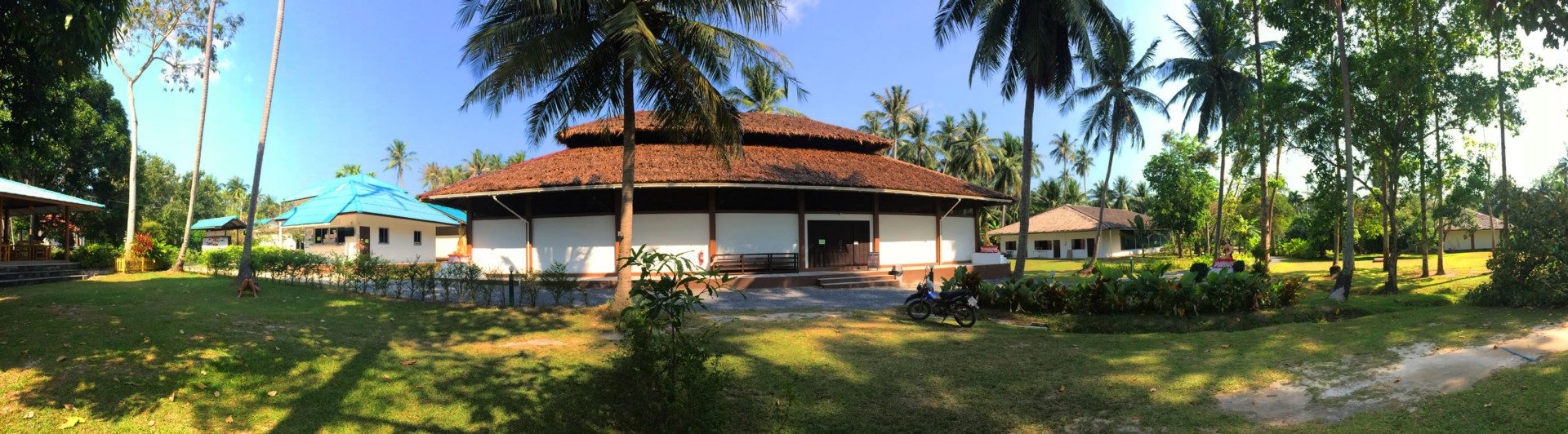
Enjoy a fresh mango and coconut for breakfast, take a Yoga class, relax on a hammock with an ocean view, and save a massage for the afternoon. These are just a few ways to spend a perfect day on the beautiful island of Koh Phangan in Thailand, where Agama is located. Nature is constantly blessing Koh Phangan with blue skies, breathtaking sunsets and short, refreshing rain showers to cool down the tropical weather.
Agama is the pioneer of Yoga on the tropical island paradise of Koh Phangan, Thailand. The school was founded on the island in 2003 by Swami Vivekananda Saraswati, a Yogi for over 30 years who has dedicated his life to teaching an authentic form of Hatha Yoga in a modern scientific approach.
Agama believes that there should be a bridge between spirituality and rational thinking, and classes are taught accordingly. The teachings are easy to implement in daily life and are often adopted immediately by students.
FOLLOW THESE LINKS TO LEARN EVERYTHING YOU NEED TO KNOW:
- Sample Itinerary for One-Day Activities
- Getting To Koh Phangan Island. Lomprayah Boat Ferry
- Lodging, Hotels, Bungalows, and Housing
- General Campus Information
- Learn Everything About the Typical Agama Experience
- Complete Koh Phangan Island Information. Phanganist
Agama is unique among Yoga schools in this world, offering a style of Yoga that combines authentic wisdom from India and Tibet with a Western mindset, giving students the rare opportunity to practice forgotten, sacred teachings from the East.
The Agama program consists of principles and techniques from various styles of Yoga, including:
- Hatha Yoga
- Kundalini Yoga
- Tantra Yoga
- Kriya Yoga
- Raja Yoga
- Karma Yoga
- Jnana Yoga
- Nidra Yoga
- Bhakti Yoga